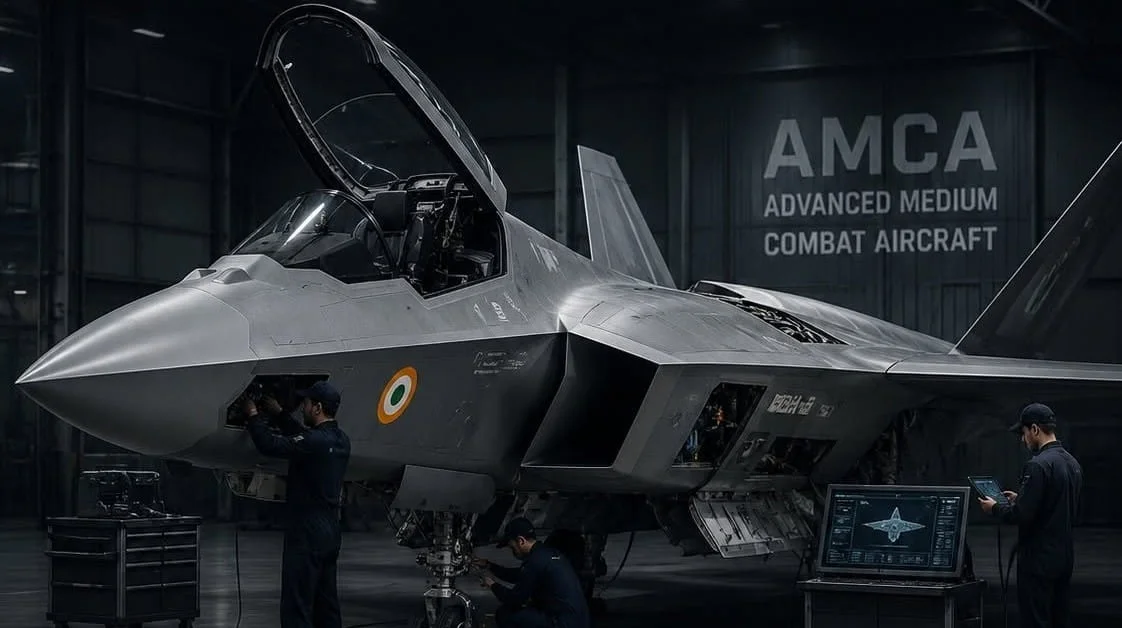
New Delhi: India’s Advanced Medium Combat Aircraft (Advanced Medium Combat Aircraft) is being designed with a strong emphasis on long-term operational sustainability, with planners reportedly prioritising AI-enabled predictive maintenance alongside stealth and combat performance.
The approach reflects lessons drawn from global fifth-generation fighter programs, where high maintenance complexity and low mission readiness have emerged as significant operational challenges.

Balancing Stealth with Sustainment Efficiency
While modern stealth aircraft are typically evaluated on radar evasion, sensor fusion, and high-speed performance, real-world operations have highlighted a less discussed issue—sustainability.
Aircraft such as the F-35 have faced criticism over maintenance-heavy stealth coatings, software complexity, and logistical delays, which can reduce overall fleet availability during sustained operations.
Against this backdrop, India’s defence planners aim to ensure that the AMCA avoids similar pitfalls by embedding maintainability into the aircraft’s core design philosophy.
AI-Powered Predictive Maintenance System
A key feature of the program is the integration of an Integrated Vehicle Health Management (IVHM) system, supported by artificial intelligence and digital twin modelling.
The system is expected to continuously analyse real-time data from onboard sensors tracking vibration patterns, thermal changes, and electrical performance. By identifying early signs of component fatigue, the aircraft will be able to predict potential failures before they occur.
This predictive capability could allow ground crews to prepare replacement parts in advance, significantly reducing turnaround time between sorties and improving mission availability rates.
Shift from Scheduled to Condition-Based Servicing
Unlike traditional maintenance models that rely on fixed inspection intervals, the AMCA is expected to adopt a condition-based servicing approach.

This means components will be serviced or replaced based on actual wear and performance data rather than predetermined timelines, improving efficiency and reducing unnecessary downtime.
Embedded Stealth and Structural Monitoring
Another major design innovation is the integration of radar-absorbing materials directly into the aircraft’s composite structure, reducing dependence on externally applied stealth coatings that typically require frequent maintenance.
In addition, fibre-optic sensors embedded within the airframe are expected to continuously monitor structural stress and fatigue. This would allow engineers to assess the aircraft’s health from within the structure itself, reducing the need for extensive manual inspections.
Modular Systems for Faster Repairs
The AMCA is also expected to use a modular architecture based on Line Replaceable Units (LRUs), allowing faulty avionics or sensor systems to be quickly swapped on the ground.
This design approach enables rapid isolation of technical issues and minimizes aircraft downtime, as defective modules can be repaired separately without grounding the entire platform.
Focus on Combat Readiness and Fleet Availability
The overarching objective of the program is to ensure high mission readiness in operational conditions. Reports suggest a target fleet availability rate of around 75%, reflecting the Indian Air Force’s need for sustained operational capability in a two-front security environment.
By combining stealth technology with AI-driven maintenance and modular design, the AMCA is being developed not just as an advanced fighter, but as a platform optimised for long-term endurance and rapid sortie generation.
If successful, the approach could mark a shift in how future combat aircraft are designed—placing equal importance on battlefield performance and real-world maintainability.